Fortifying Specialty Gas Safety: Core Functions and Proper Use of Cylinder Flow Restrictors
In high-end fields such as semiconductor manufacturing and electronic specialty gas applications, the safe delivery and precise control of specialty gases – silane, disilane, diborane, phosphine, arsine, hydrogen – are critical for process stability and personnel safety.
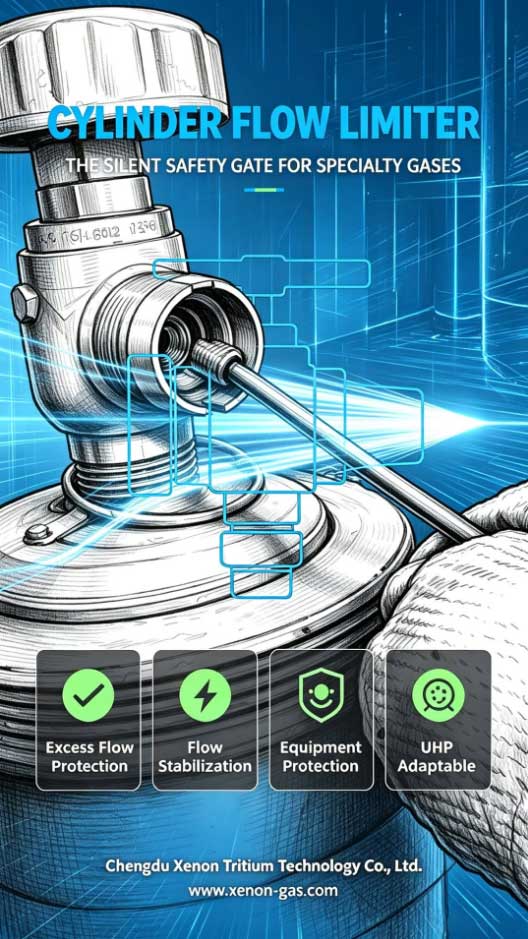
The cylinder flow restrictor, installed at the cylinder outlet, serves as the “safety gate” and “flow stabilizer” of the specialty gas system.
I. Four Core Functions of Flow Restrictors
1. Emergency Flow Limiting – Eliminate Leak Risks
High-pressure specialty gas cylinders can reach up to 3,000 PSI (20.7 MPa), while mainstream semiconductor Y‑Ton cylinders are rated at 2,400 PSI (16.6 MPa).
In the event of line rupture, regulator failure, or misoperation, a sudden high-pressure gas release can easily cause explosion or poisoning. The restrictor contains a sintered porous metal or precision orifice plate structure, automatically limiting the maximum leak rate to a safe level and buying critical time for emergency response.
✅ Compliant with mandatory requirements of GB 50646-2020.
2. Precise Flow Stabilization – Ensure Process Accuracy
Semiconductor etching, deposition, and doping processes demand extremely high flow stability (typically ±0.5% to ±1%).
The restrictor stabilizes outlet flow in the range of 0.5–5 SLPM, counteracting flow drift caused by cylinder pressure decay and ambient temperature fluctuations, ensuring process consistency and wafer yield.
3. Downstream Protection – Extend Equipment Life
It cushions high-pressure surges and, in its porous metal version, filters particles, protecting downstream precision components such as pressure regulators and MFCs.
Suitable for 6N–9N ultra‑high purity gases (covering mainstream purity requirements for advanced semiconductor nodes).
4. Gas‑Specific Design – Targeted for Different Scenarios
All‑metal seal design, no rubber/plastic parts:
- Pyrophoric gases (silane, disilane) and highly toxic gases (diborane, phosphine, arsine) → porous metal structure recommended
- Hydrogen and other stable gases → fixed orifice plate option
💡 Some integrated restrictors also feature a check valve function to prevent backflow contamination.
II. Proper Use: Installation, Selection, and Maintenance
1. Installation Requirements – First Barrier on the High‑Pressure Side
| Item | Requirement |
|---|---|
| Correct sequence | Cylinder valve → Restrictor → Regulator → Downstream line |
| Prohibited | ❌ Never reverse direction; never install downstream of the regulator |
| Connection | Standard 1/4″ VCR metal seal; older cylinders may use CGA/DISS |
| Environment | UHP ultra‑clean packaging; install in dust‑ and oil‑free conditions |
2. Selection Essentials – Mandatory for High‑Risk Gases
- Material (must‑have) : 316L VAR/VIM-VAR vacuum‑melted stainless steel, electropolished (Ra ≤ 0.5 μm), 100% helium leak tested (leak rate ≤ 1×10⁻⁹ std cm³/s). No 304 stainless steel or brass.
- Flow rating : Common sizes 0.5, 1, 2, 5 SLPM; custom available.
- Design type : Pyrophoric/toxic gases → sintered porous metal; stable gases (e.g., H₂) → fixed orifice plate.
3. Maintenance – Adjustment‑Free, Periodic Leak Checks
| Item | Description |
|---|---|
| Normal operation | No manual adjustment; no wear parts |
| Inspection | Quarterly helium leak check on connections |
| Replacement interval | Standard gases: 3–5 years; high‑risk gases (silane, phosphine, etc.) : annually recommended |
| Prohibited actions | ❌ Never disassemble, drill, or modify the internal flow path |
III. Summary
The flow restrictor is a fundamental safety component of semiconductor specialty gas systems – small in size, big on safety. It stabilizes processes and prevents leaks.
Proper selection (316L + VCR + metal seal), correct installation (cylinder outlet, high‑pressure side), and regular leak checks are the keys to building a robust specialty gas safety barrier.
Chengdu Xenon Tritium Technology Co., Ltd.
Focusing on high‑purity specialty gas supply and safety components for the semiconductor and electronics industries. Welcome to connect.